Appendix B — Appendix B: Solutions to Practice
B.1 Chapter 1: The Language of Geometry
B.1.1 Solutions to Practice
- Confidence Check (label each statement):
- “A line segment is a part of a line with two endpoints.” is a Definition.
- “Through any two distinct points, there is exactly one line.” is a Postulate.
- “Vertical angles are congruent.” is a Theorem.
B.2 Chapter 2: Star Polygons
B.2.1 Solutions to Practice
- Sketch should show a 9-point star using step size 4 (notation \(\{9/4\}\)).
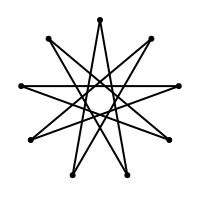
One valid turning angle label is
\[ \theta=\frac{360^\circ(4)}{9}=160^\circ. \]
\(\{10/2\}\) is disconnected because \(\gcd(10,2)=2>1\). 10 and 2 have common factors, so it is a compound star polygon. Compound star polygons are not connected. You have to lift up your pen/pencil to create it.
\(\{12/3\}\) is disconnected since \(\gcd(12,3)=3\). It splits into 3 identical components. Since 12 and 3 have common factors besides 1, so it is a compound star polygon. Compound star polygons are not connected. You have to lift up your pen/pencil to create it.
Yes. \(\{10/3\}\) and \(\{10/7\}\) are identical because \(\{n/k\}=\{n/(n-k)\}\).
For \(\{7/2\}\),
\[ \theta=\frac{360^\circ(2)}{7}=\frac{720^\circ}{7} \]
\[ \alpha=180^\circ-\theta=180^\circ-\frac{720^\circ}{7}=\frac{540^\circ}{7}\approx77.14^\circ \]
- For \(\{11/4\}\),
\[ \theta=\frac{360^\circ(4)}{11}=\frac{1440^\circ}{11}\approx130.91^\circ \]
\[ \alpha=180^\circ-\theta=180^\circ-\frac{1440^\circ}{11}=\frac{540^\circ}{11}\approx49.09^\circ \]
- Sketches should show all unique star polygons for \(\{6/k\}\):
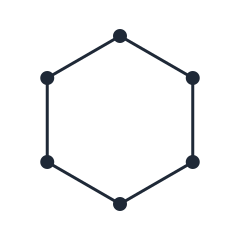 \(\{6/1\}=\{6/5\}\) |
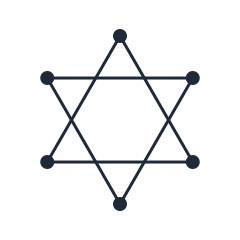 \(\{6/2\}=\{6/4\}\) |
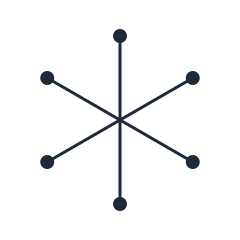 \(\{6/3\}\) |
|---|
B.3 Chapter 3: Sequences
B.3.1 Solutions to Practice
\(2,6,18,54,\ldots\) is geometric with \(r=3\).
\(7,12,17,22,\ldots\) is arithmetic with \(d=5\).For \(4,9,14,19,\ldots\):
Explicit: \(a_n=4+(n-1)5=5n-1\)
Recursive: \(a_1=4\), \(a_n=a_{n-1}+5\) for \(n\ge2\).\(a_{12}=a_1r^{11}=3(2^{11})=6144\).
Arithmetic with \(a_1=10\), \(d=3\), \(a_{15}=52\):
\[ S_{15}=\frac{15}{2}(10+52)=465 \]
Given \(a_1=2\), \(a_n=a_{n-1}+5\):
Explicit: \(a_n=2+5(n-1)=5n-3\)
\(a_{10}=5(10)-3=47\).\(81\left(\frac13\right)^{n-1}=1\) gives \(\left(\frac13\right)^{n-1}=\frac1{81}=\left(\frac13\right)^4\), so \(n=5\).
Differences are \(5,7,9,\ldots\), so next difference is \(11\). Next term is \(24+11=35\).
Geometric with \(a_1=5\), \(r=2\), \(n=8\):
\[ S_8=5\frac{1-2^8}{1-2}=5(255)=1275 \]
B.4 Chapter 4: Figurate Numbers, FIBS, and Sums
B.4.1 Solutions to Practice
\[ T_{12}=\frac{12(13)}{2}=78 \]
First 10 Fibonacci numbers: \(1,1,2,3,5,8,13,21,34,55\).
\[ \sum_{k=1}^{15}k=\frac{15(16)}{2}=120 \]
\[ \sum_{k=1}^{10}k^2=\frac{10(11)(21)}{6}=385 \]
- A standard identity is
\[ n^2=T_n+T_{n-1} \]
so each square number is the sum of two consecutive triangular numbers.
\[ P_7=\frac{7(3\cdot7-1)}{2}=\frac{7(20)}{2}=70 \]
\[ 35+36+\cdots+85 \]
There are \(85-35+1=51\) terms, average is \(\frac{35+85}{2}=60\), so sum is \(51(60)=3060\).
Sum of first 20 odd integers is \(20^2=400\).
Sum of first 20 even integers is \(20(21)=420\).
B.5 Chapter 5: Polygons and Polyhedra
B.5.1 Solutions to Practice
- Regular pentagon interior angle:
\[ \frac{(5-2)180^\circ}{5}=108^\circ \]
The measure of a central angle equals the measure of its intercepted arc.
Answers depend on the specific diagram used.
For a 14-gon,
\[ \text{Interior sum}=(14-2)180^\circ=2160^\circ \]
If regular, each interior angle is
\[ \frac{2160^\circ}{14}=\frac{1080^\circ}{7}\approx154.29^\circ \]
- For a quadrilateral:
\[ (x+10)+(x+20)+(x+30)+(x+40)=360 \]
\[ 4x+100=360 \Rightarrow x=65 \]
Angles: \(75^\circ,85^\circ,95^\circ,105^\circ\).
\[ (n-2)180^\circ=1980^\circ \Rightarrow n-2=11 \Rightarrow n=13 \]
It is a 13-gon (tridecagon).
- Using \(F+V=E+2\):
\[ 12+20=E+2 \Rightarrow E=30 \]
B.6 Chapter 6: Tessellations and Fractals
B.6.1 Solutions to Practice
The regular tessellations are by equilateral triangles, squares, and regular hexagons.
A regular pentagon cannot tessellate by itself because its interior angle is \(108^\circ\), and \(360^\circ/108^\circ\) is not an integer.
Triangle-square-hexagon-square gives
\[ 60^\circ+90^\circ+120^\circ+90^\circ=360^\circ \]
so this is a valid vertex arrangement.
- Regular
- Semi-regular
- Neither
- Regular
With \(N_n=3^n\):
\(N_4=3^4=81\)
\(N_6=3^6=729\).Self-similarity means a pattern contains smaller copies of the same shape at different scales. One example is the Sierpinski triangle.
B.7 Chapter 7: Symmetry, Isometries, and Frieze Patterns
B.7.1 Solutions to Practice
Square: 4 lines. Regular hexagon: 6 lines. Capital letter \(A\): usually 1 vertical line.
For a regular octagon, smallest rotational symmetry angle is
\[ \frac{360^\circ}{8}=45^\circ \]
- Translation
- Reflection
- Rotation
- Glide reflection
- Translation
- Apply \((x,y)\to(x-3,y+4)\) to \((5,-2)\):
\[ (5,-2)\to(2,2) \]
Translation plus glide reflection only is frieze type step.
No. A dilation is not an isometry because it changes distances (except the trivial scale factor 1 case).
B.8 Chapter 8: Conic Sections
B.8.1 Solutions to Practice
- One correct matching:
- Circle: plane parallel to the base of the cone
- Ellipse: plane cuts at an angle and intersects one nappe
- Parabola: plane parallel to a slant side (generator)
- Hyperbola: plane cuts both nappes
- Cylinder with \(r=4\), \(h=9\):
\[ V=\pi r^2h=\pi(16)(9)=144\pi \]
\[ SA=2\pi rh+2\pi r^2=2\pi(4)(9)+2\pi(16)=104\pi \]
- Cone with \(r=5\), \(h=12\):
\[ \ell=\sqrt{r^2+h^2}=\sqrt{25+144}=13 \]
\[ SA=\pi r\ell+\pi r^2=\pi(5)(13)+\pi(25)=90\pi \]
- Sphere with \(r=6\):
\[ V=\frac{4}{3}\pi r^3=\frac{4}{3}\pi(216)=288\pi \]
\[ SA=4\pi r^2=4\pi(36)=144\pi \]
True. A circle is a special case of an ellipse (equal semi-axes).
Kepler described planetary orbits as ellipses (with the Sun at a focus). Newton formulated universal gravitation, which explains conic orbits. Hypatia wrote and taught mathematical astronomy and is associated with work/commentary on conic geometry traditions.