5 4. Figurate Numbers, FIBS, and Sums
5.1 Learning Goals
- Recognize triangular, square, and pentagonal figurate number patterns.
- Compute terms of the Fibonacci sequence and identify recursive structure.
- Use closed-form and sigma notation to evaluate finite sums.
- Compute figurate numbers using their formulas (triangular, square, and pentagonal).
- Creating figurate numbers as geometric shapes.
- Computing the sum of consecutive integers using Gauss’ Method.
- Determine the sum of consecutive even integers.
- Determine the sum of consecutive odd integers.
- Create a FIB poem.
- Recognize a FIB poem.
5.2 Key Terms and Formulas
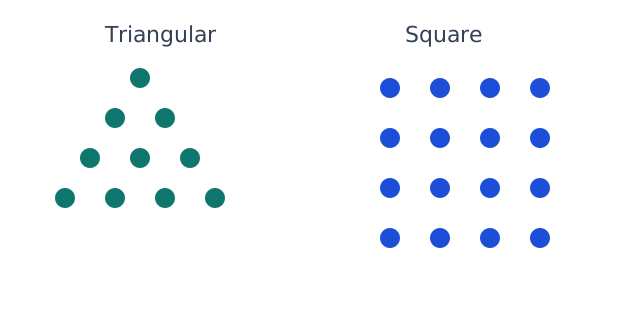
Triangular numbers count dots that form an equilateral triangular pattern:
\[ T_n = 1+2+\cdots+n = \frac{n(n+1)}{2} \]
Square numbers count dots in an \(n \times n\) square:
\[ S_n = n^2 \]
Pentagonal numbers:
\[ P_n = \frac{n(3n-1)}{2} \]
Fibonacci numbers are defined recursively by
\[ F_1=1,\quad F_2=1,\quad F_n=F_{n-1}+F_{n-2}\;\text{for }n\ge 3 \]
Useful finite sums:
\[ \sum_{k=1}^n k = \frac{n(n+1)}{2}, \qquad \sum_{k=1}^n k^2 = \frac{n(n+1)(2n+1)}{6} \]
Sums of consecutive even and odd integers:
\[ 2+4+\cdots+2n = n(n+1), \qquad 1+3+\cdots+(2n-1)=n^2 \]
5.3 Mini-Lecture
Find the 8th triangular number and the sum \(1+2+\cdots+8\).
By the triangular-number formula,
\[ T_8 = \frac{8(9)}{2}=36 \]
So,
\[ 1+2+\cdots+8 = 36 \]
This shows how figurate-number patterns connect directly to finite sums.
5.4 Practice
- Compute \(T_{12}\) and interpret it as a dot pattern.
- List the first 10 Fibonacci numbers.
- Evaluate \(\sum_{k=1}^{15} k\).
- Evaluate \(\sum_{k=1}^{10} k^2\).
- Explain why every square number is the sum of two consecutive triangular numbers.
- Compute the 7th pentagonal number \(P_7\).
- Use Gauss’ Method to find \(35+36+\cdots+85\).
- Find the sum of the first 20 odd integers.
- Find the sum of the first 20 even integers.
5.5 Art and Design Connections
- Construct dot-art posters for triangular and square numbers, then caption each with its formula and visual growth pattern.
- Design a Fibonacci spiral collage from rectangles with side lengths from the sequence and evaluate composition balance.
- Plan a light-installation layout where LED counts per row follow figurate-number sums to create controlled density gradients.
5.6 Creative Assignment
5.6.1 Creative Assignment for this Chapter
(Creative Homework Assignment: FIBS)
Your creative assignment is to create an original FIB poem that is at least six lines.
It must be a FIB as described in this chapter. This is an extra credit creative assignment that can replace a missing one for the course.
5.6.2 Examples and More Information
- See the module folder on our course site for examples that would get credit and bonus for this creative homework assignment.
5.7 Exercises
5.7.1 Exercises for this Chapter
- Make sure you are logged into your FIT Google account or else you will not view the link below.
- Once you have your answers, submit them carefully through our course site on Brightspace by the deadline.
The above are the Textbook Exercises for my MA142 students.
5.7.2 More Exercises
These questions are for anyone! They are not required for my students.
Figurate Numbers. Find the 8th triangular number, the 5th square number, and the 4th pentagonal number. Show the formula you used for each.
Fibonacci Sequence. The Fibonacci sequence starts \(1, 1, 2, 3, 5, 8, \ldots\)
- Write a recursive formula for \(F_n\).
- List the first 12 terms of the Fibonacci sequence.
- What is the ratio \(F_{12}/F_{11}\)? What famous constant does this ratio approach?
Gauss’s Method. Use Gauss’s Method to find the sum of the integers from 1 to 200. Show your reasoning.
Sigma Notation. Evaluate: \(\displaystyle\sum_{k=1}^{6} (2k - 1)\). What do you notice about the result?
Fashion & Art Connection. The Fibonacci sequence appears throughout fashion and design. The “golden rectangle” — whose side lengths are in the ratio of consecutive Fibonacci numbers — is used in fabric cutting, logo proportions, and garment design. Karl Lagerfeld was famously inspired by mathematical proportions.
- The 10th and 11th Fibonacci numbers are 55 and 89. If a designer wants a golden-ratio rectangle with a shorter side of 55 cm, approximately how long should the longer side be?
- Triangular numbers appear in stacked arrangements — like a pyramid display of folded scarves: 1 on top, then 2, then 3, and so on. If a department store display has 6 rows, how many scarves are in the display in total?