8 7. Symmetry, Isometries, and Frieze Patterns
8.1 Learning Goals
- Identify symmetry in terms of shapes, patterns, words, capital letters, and more.
- Determine lines of reflection.
- Identify rotational symmetry (180 degrees).
- Describe and identify all four isometries.
- Define the compound isometry.
- Distinguish when there is an isometry and when there is not an isometry.
- Identify isometries in a frieze pattern.
- Write which isometry is present in every frieze pattern.
- Identify a frieze pattern using the terms hop, step, sidle, jump, spinning hop, spinning sidle, and spinning jump.
- Create frieze patterns.
8.2 Key Terms and Formulas
A line of reflection symmetry divides a figure into mirror-image halves.
Rotational symmetry means a figure maps onto itself after a turn less than \(360^\circ\).
Isometries (distance-preserving transformations):
- translation
- reflection
- rotation
- glide reflection
Coordinate rules for common isometries:
\[ \text{Translation by }\langle a,b\rangle: \ (x,y)\to(x+a,y+b) \]
\[ \text{Reflection across }x\text{-axis}: \ (x,y)\to(x,-y) \]
\[ \text{Reflection across }y\text{-axis}: \ (x,y)\to(-x,y) \]
\[ \text{Rotation }180^\circ\text{ about origin}: \ (x,y)\to(-x,-y) \]
Compound isometry: composition of two or more isometries.
Every frieze pattern includes translation symmetry.
8.3 Mini-Lecture
Coordinate geometry connects pictures to equations. Use the distance and midpoint formulas to measure and locate points precisely, then use slope to classify line relationships such as parallel and perpendicular.
8.4 Practice
- How many lines of reflection symmetry does each have: a square, a regular hexagon, and the capital letter \(A\)?
- Find the smallest angle of rotational symmetry for a regular octagon.
- Identify the isometry: (a) slide right 6 units, (b) flip over the \(x\)-axis, (c) rotate \(180^\circ\) about the origin, (d) reflect over a line then translate along that line.
- Apply a translation by \(\langle -3,4\rangle\) to the point \((5,-2)\).
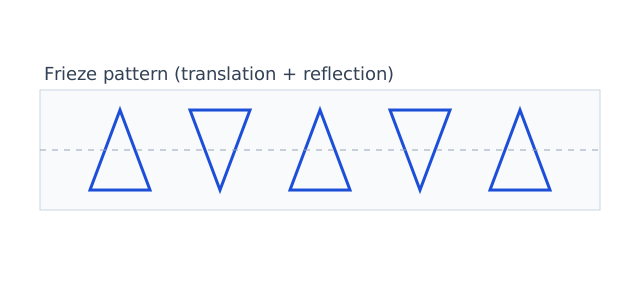
- A border pattern has translation and glide reflection, but no reflection line or 180-degree rotation. Which frieze type is it?
- Is a dilation an isometry? Explain why or why not in one sentence.
8.5 Art and Design Connections
- Design a frieze border for a webpage or poster and identify all isometries present in the final pattern.
- Analyze a wallpaper sample for reflection and rotational symmetries, then classify its repeated motif structure.
- Create a brand mark with one intentional symmetry break to study how asymmetry changes emphasis and movement.
8.6 Creative Assignment
8.6.1 Creative Assignment for this Chapter
(Creative Homework Assignment #5: Isometry)
Your fifth creative assignment is to create an original piece of art that involves an isometry.
- So many possibilities for this one: you do not have to create a frieze pattern but you are definitely welcome to do one. You can submit an assignment that has one isometry or more. It is up to you.
- it can be multiple conic sections or
- it can be one type of conic section many times!
You can decide which of these three options. You can do this in any way you want.
8.6.2 Examples and More Information
- See the module folder on our course site for examples that would get credit and bonus for this creative homework assignment.
- For information on how these assignments work; the grading rubric; and the voting you can look in Chapter 9 of this textbook or many places on our course site!
- The more effort you put in for these assignments, the more bonus you get on exams. It helps if you write how long it took you to complete your work and how you created your assignment.
8.7 Exercises
8.7.1 Exercises for this Chapter
- Make sure you are logged into your FIT Google account or else you will not view the link below.
- Once you have your answers, submit them carefully through our course site on Brightspace by the deadline.
- Symmetry Exercises (Google Doc)
The above are the Textbook Exercises for my MA142 students.
8.7.2 More Exercises
These questions are for anyone! They are not required for my students.
- Lines of Symmetry. How many lines of reflection symmetry does each shape have?
- Equilateral triangle
- Square
- Regular hexagon
- Circle
- Rotational Symmetry. State the smallest angle of rotation that maps the figure onto itself:
- A regular pentagon
- The letter S
- A regular octagon
- Isometry Identification. For each transformation, identify the isometry (reflection, rotation, translation, or glide reflection):
- Moving a shape 5 units to the right without turning or flipping it.
- Flipping a shape over the \(x\)-axis.
- Reflecting a shape over a line, then translating it along that same line.
- Rotating a shape 90° around a fixed point.
- Frieze Patterns. Identify the frieze pattern type (hop, step, sidle, jump, spinning hop, spinning sidle, or spinning jump) for each description:
- The pattern only has translational symmetry.
- The pattern has a vertical line of reflection and translational symmetry, but no other symmetries.
- The pattern has a glide reflection and translational symmetry only.
- Fashion Connection. Textile and fabric design relies heavily on symmetry and frieze patterns. Border prints on scarves, sari edges, and wallpaper trims are real-world frieze patterns.
- A scarf border repeats a feather motif that is reflected vertically and can also be flipped upside-down. Which frieze pattern type is this? (Hint: think about which symmetries are present.)
- The Louis Vuitton monogram pattern is famous for its repeating LV logo. Does the LV logo itself have any lines of reflection symmetry? Does it have rotational symmetry? Explain.
- Name one capital letter of the alphabet that has both a horizontal and a vertical line of symmetry.